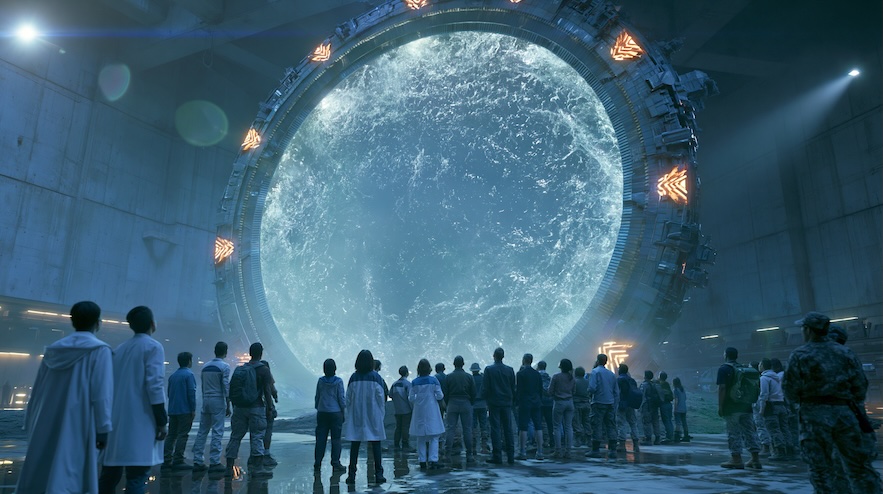
On June 2, 2026, Amazon MGM Studios quietly killed the Stargate revival it had announced with fanfare just seven months earlier. The show had a full series order, a writers’ room nearly twenty weeks deep, a showrunner in Martin Gero who grew up inside the franchise, and department heads of the calibre of production designer Nathan Crowley. It was due to shoot this autumn. The stated concern, per Variety’s reporting: executives worried the series “would not have broad appeal beyond the franchise’s already dedicated fanbase.”
Strip away the euphemism and you find a familiar anxiety. Amazon Prime Video has a reputation problem it is acutely aware of: it is the home of what the industry half-jokingly calls “Dad shows”: Reacher, Bosch, Jack Ryan, Tom Clancy adaptations, The Terminal List. These are successful, profitable, beloved shows. But a streamer cannot grow by deepening its hold on an audience it already owns. Growth lives with viewers it doesn’t have yet, and those viewers are younger. So when a new executive regime looks at a lore-rich revival of a franchise whose flagship series ended in 2007, the dashboard says: this serves the existing base. Cancel.
The logic is internally consistent. It is also, on the evidence of the last five years of franchise television, almost exactly backwards. Because the “modern audience” that decision was made on behalf of does not exist, at least not in the form executives imagine it.
The Modern Audience Is a Spreadsheet Fiction
When a studio says “modern audience,” it almost never means actual people who were observed wanting actual things. It means a composite, reverse-engineered from demographic targets: younger, more diverse, less patient, allergic to continuity, hungry for romance subplots and contemporary banter, intimidated by lore. It is the old broadcast-era “four-quadrant” model with a Gen Z coat of paint, a persona built in a planning deck, not discovered in the world.
The tell is what happens when shows are built for this imaginary person. They are designed by subtraction. Strip the continuity, because the modern audience finds it a barrier to entry. Lower the competence of the legacy institution, because the modern audience supposedly distrusts institutions. Centre interpersonal drama, because the modern audience came from teen TV. Make the leads young, because young people only watch young people.
The shows that result fail with everyone, including, conspicuously, the young.
The Graveyard of Shows Built for People Who Don’t Exist
The Acolyte (2024) was Lucasfilm’s explicit play for a newer, broader Star Wars audience: a younger ensemble, a fresh era, deliberately light continuity requirements. It cost a reported sum in the region of $180 million for eight episodes and was cancelled after a single season, having posted the weakest engagement trajectory of any live-action Star Wars series. Whatever one thinks of the discourse around it, the strategic fact is brutal: the new audience it was designed for did not show up, and the existing audience it was designed around did not stay.
Star Trek: Starfleet Academy (2026) is the freshest corpse, and the most instructive because it was made shortly before the green light was given to new Stargate. It is, on paper, everything the imaginary modern audience wants: young cadets, friendships, rivalries, first loves, an academy coming-of-age frame. Critics liked it: 85–88% on Rotten Tomatoes. Audiences did not: the audience score sat in the 40s, and within two weeks of its January premiere the show had fallen out of Paramount+’s top ten in the US and at least eight other countries, while South Park, Tulsa King and Landman (“Dad shows,” ironically) held the chart. The recurring audience complaint was not “too many aliens,” but that the show felt like a generic young-adult drama wearing the franchise as set dressing: romance triangles and unearned big-speech moments where competence, rigour and wonder used to be. It’s easy to dismiss a gap like this as review bombing, but we seriously have to question why people choose to review bomb. Too many people wave it away as toxic fandom from a vocal minority. But what if it isn’t?
The pattern repeats across Willow, Halo, and others: shows that treated “young” as a genre rather than a demographic, and treated the franchise’s actual substance as the obstacle rather than the asset.
Here is the crucial point, and it needs saying plainly because the discourse around these failures is so often hijacked: the failure was not diversity, and it was not youth. Arcane, The Last of Us, Fallout, One Piece, Wednesday: these are diverse, modern, frequently young-led shows that became era-defining hits with the exact audience Amazon wants. The difference is that they were built by addition, not subtraction. They trusted their source material’s depth, treated their audiences as intelligent, and let representation live inside excellent storytelling rather than in place of it. Young viewers didn’t reject The Acolyte or Starfleet Academy because those shows had diverse casts. They rejected them because the shows were condescending, built for a focus-grouped sketch of who young people are rather than for who they demonstrably are.
A quick word in defence of the people who actually wrote these shows: the writers usually get the blame, but let’s be honest, when they’re handed strict guidelines to work within, it’s the framework that’s the problem, not the writers. They’re just doing a job.
How Tech Companies See Audiences, and Why It Misleads Them
Amazon is not a television company that happens to be owned by a tech giant; it is a tech company that happens to make television. That matters, because tech companies see audiences through instrumentation: cohorts, completion rates, churn curves, top-of-funnel acquisition. In that worldview, an audience is a segment: a set of attributes (age 18–34, watches genre, churns at month three) to be captured with content engineered to the segment’s profile.
The rest of the world (and crucially, the actual modern younger audience) doesn’t organise itself by segment, but instead by fandom. It lives in taste communities: Discord servers, subreddit lore threads, TikTok edit ecosystems, YouTube video essays, fan wikis with article counts that rival small encyclopedias, Twitch streams where someone plays a twenty-year-old game to forty thousand concurrent viewers. A segment is something you target. A fandom is something you feed, and when fed, it does your marketing for you, for free, at a scale no campaign budget can match.
This is why the “lore is a barrier to entry” assumption (reportedly the core anxiety about Gero’s take) is not just wrong but inverted for this generation. Gen Z is the most lore-literate cohort in entertainment history. These are people who watched ten-hour Elden Ring lore explainers for a game that barely has dialogue, who turned the Fallout wiki into a pilgrimage site, who resurrected Suits (a decade-old USA Network procedural) into Netflix’s most-watched acquisition of 2023 purely through algorithmic word of mouth. Depth should not be seen as a barrier, but instead as a content engine: every mystery, every callback, every piece of continuity is raw material for the explainer videos, edits, theories and iceberg charts through which young audiences actually discover shows.
Amazon, of all companies, should know this, because Amazon proved it. Fallout is the single most relevant data point in this entire discussion, and it argues against the Stargate decision. A 25-year-old franchise. Dense, weird, continuity-laden lore, adapted faithfully and respectfully rather than sanded down. Result: one of Prime Video’s biggest launches ever, a measurably young audience, a surge in sales of decades-old games, and a second season that arrived as an event. Invincible tells the same story. The lesson Amazon’s own catalogue teaches is: legacy genre IP, taken seriously, is a youth-acquisition machine.
What the Modern Younger Audience Actually Is
If you build the profile from observed behaviour rather than boardroom anxiety, the modern younger audience looks like this:

Sincerity-seeking. After a decade of grimdark and a decade of ironic quip-armour, the breakout hits with under-35s (Ted Lasso, Fallout’s Lucy, Andor’s quiet conviction, the entire cosy-optimism wave) are earnest. They want shows that believe in something.
Competence-hungry. The fan shorthand is “competence porn”: teams of capable people solving hard problems. Found-family ensembles of professionals, which is, almost to the letter, the description of SG-1.
Discovery-native. They don’t find shows through billboards; they find them through clips, edits, essays and friends’ Discords. A show’s “marketability” to them is a function of how clippable, memeable, theorisable and wiki-able it is.
Back-catalogue fluent. They treat the entire history of television as a flat, simultaneous library. The Office, Suits, Twin Peaks, The X-Files: age of content is irrelevant; availability and word of mouth are everything. A franchise with 354 existing episodes sitting on your own platform is not baggage. It is a pre-installed funnel.
Allergic to being pandered to. Nothing kills a show with this cohort faster than the perceptible smell of a corporation doing an impression of them.
Why Stargate Is Almost Suspiciously Well-Suited to This Audience
Look at Stargate through that lens rather than through the dashboard, and the cancelled revival starts to look like an unforced error:
It’s the original competence-porn found-family show. A small team of soldiers and scientists, sincere to a fault, solving problems with cleverness rather than grimness. SG-1’s DNA is the exact tonal register young audiences have been migrating toward.
It’s optimistic, Earth-based science fiction: contemporary people walking through a ring into wonder. Low cosplay barrier, instantly legible premise, and the gate itself is one of the great visual hooks in genre history: a perfect eight-second TikTok image.
The structure is binge-and-clip native by accident. Stargate’s classic format (episodic adventures threaded on serialized mythology) is precisely the dual-track structure that wins now: casual viewers can drop in anywhere (the Suits/comfort-rewatch economy), while the serialized spine feeds the theory-and-essay ecosystem.
The funnel already exists, on Amazon’s own servers. Hundreds of hours of SG-1, Atlantis and Universe sit on Prime Video right now, generating watch-hours Amazon can measure. A new series doesn’t start from zero awareness; it activates a dormant library the way Cobra Kai activated Karate Kid and Fallout activated its games.
It’s a transmedia platform waiting to happen. Games, animation, second-screen lore content, the Fallout playbook, in reverse.
The irony is that “won’t appeal beyond the dedicated fanbase” describes the failure mode of ignoring these properties, not of embracing them.
The dedicated fanbase is not the ceiling. It is the ignition system.