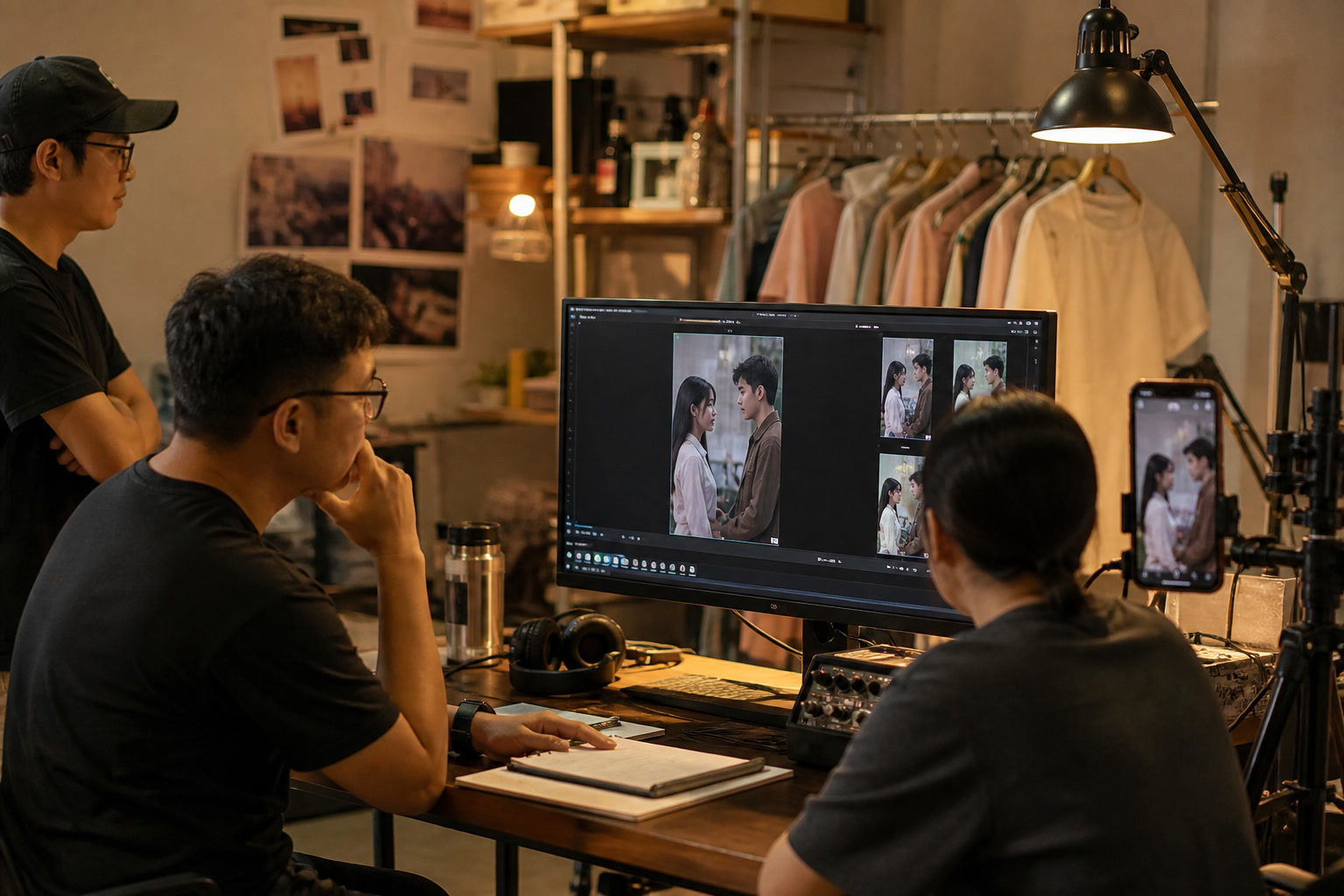
Hollywood is still arguing about whether AI belongs on a film set. In China’s ultrashort-drama hubs, that argument already had consequences you can count: fewer shoots, smaller crews, and warehouses full of costumes that no longer need a stage.
I found myself sitting with two pieces of reporting that belong next to each other. Sixth Tone spent time in Zhengzhou and Wuxi, walking through companies that used to make live-action shorts at industrial scale. Variety described Hollywood racing into the same vertical format, with one-minute episodes and budgets that look tiny next to a network drama. If you teach storytelling, or you just care about how pictures get made, this is a useful moment to look at what already happened, not only at what might.
What winter looked like in Zhengzhou
Sixth Tone’s first piece, published August 24, follows Zhoutu Culture in Zhengzhou. After ByteDance’s Seedance 2.0 arrived in February, polished footage could be generated for about 1 yuan per second. Financing tightened. Live-action shoots thinned out. Output that had been around 200 titles a month fell to about 30. Staff that had peaked above 500 in 2025 dropped to around 200. The company sold a G63, an Aston Martin DB11, and a Bentley Continental GT for a combined 4.5 million yuan, about $650,000. More than 20,000 costumes were moved so an AI studio could take the space.
The China Netcasting Services Association numbers are the ones I would put on a slide. In the first quarter of 2026, more than 95 percent of 128,000 ultrashort dramas were AI-generated. Live action came back some in the second quarter after ByteDance pledged 1.5 billion yuan for live-action shorts and six platforms announced at least 6 billion yuan in planned investment. Even then, CNSA still put AI at 64 percent of Q2 releases.
Director Li Jun refused Zhoutu’s switch to AI. The pay was about 30 percent lower. Of the ten or so directors around her, eight made the jump. That is a labor story told at kitchen-table scale, and it is more honest than a keynote about disruption.
Then the work sped up in Wuxi
The August 25 follow-up moves to Qidian Interactive’s Wuxi base, which opened in April. They hired more than 50 people in a month. By June the studio was producing four to five short dramas a day, each running 30 to 44 episodes. Chen Hao built an in-house system called Yudian after Seedance 2.0. Wang Ting describes a Huishan clay-figurine fantasy that had been budgeted at 8 to 10 million yuan over three years, then finished with AI in two months for about 1 million yuan.
The people doing the work do not sound triumphant. Operators “draw cards,” regenerating a shot three to five times and hoping the next one holds. Lighting veteran Ma Shuan says every generation is a gamble, and that traditional production is something you can control. Chen Jie talks about characters that look oily, and freeze-frames that still fall apart. Chen Hao is blunt about the longer curve: if a single sentence one day makes ten minutes of video, or ninety, a lot of production jobs go with it, including possibly his.
I would keep those voices next to the throughput numbers. Speed is real. So is the sense that you are rolling dice for a face that has to survive a pause button.
Hollywood is importing the format
Variety’s August 21 feature asks whether microdramas can save a slice of Hollywood, and why this vertical boom is different from Quibi. Google and Range Media Partners launched 100 Zeros, with Kenan Thompson attached to MisTaken. A typical series is about 60 one-minute episodes, with budgets averaging $250,000. Owl & Co. puts vertical microdrama revenue outside China at $4 billion this year, up 33 percent from $3 billion in 2025.
The labor echo is already here. Enzo Semmens told Variety that 75 percent of FilmLA permits were for verticals before the AI boom. Casting director Tina Randolph Contogenis said auditions have slowed “to the point that people are panicking” as companies shift from live action to AI. Janine Czajka described the same reversal: the short-form job boom fading as platforms move to AI casts.
Some filmmakers are drawing a hard line. Guillermo del Toro said the 3D re-release of Pan’s Labyrinth used “absolutely no goddamn AI.” Christopher Nolan, talking to The Guardian, described a technology he sees as completely rejected by the public. Those quotes will travel. The Sixth Tone reporting is what I would assign first, because it shows the pipeline after the slogan.
A note on the next two weeks
IBC 2026 runs in Amsterdam from September 11 to 14, and the conference is putting authorship and production workflows on the main stage. Particle 6 founder Eline van der Velden opens with AI actor Tilly Norwood. Netflix VP of Production Anna Mallett is on virtual production, cloud post, and AI-assisted workflows. Tools such as footagen.ai have a waitlist on September 10 and a stand at FT1407. That is useful context if you will be in the hall. It is not the story that already happened in Zhengzhou and Wuxi.
Time to dig deeper
Read Sixth Tone’s Zhengzhou piece and the Wuxi follow-up, then Variety on Hollywood’s vertical rush. Map one of your own short scenes onto a 60-episode, one-minute format and ask who would still be in the room if the pictures came from a model. If you teach, put the CNSA percentages next to Li Jun’s pay cut and let students sit with both. The format is moving quickly. The people in those rooms are the ones who can tell you what it costs.