For a long time, most conversations I had about AI filmmaking started with one question: which model is best? On September 30 a handful of announcements nudged that question somewhere more interesting. A studio shipped its own production platform and video model, a Dubai producer rebuilt its workflow around AI, and a veteran Hollywood producer put a release date on three AI-assisted shorts. The question I’m hearing now is who owns the production pipeline, and I think that’s a really healthy place for the conversation to go.
A studio that builds its own tools
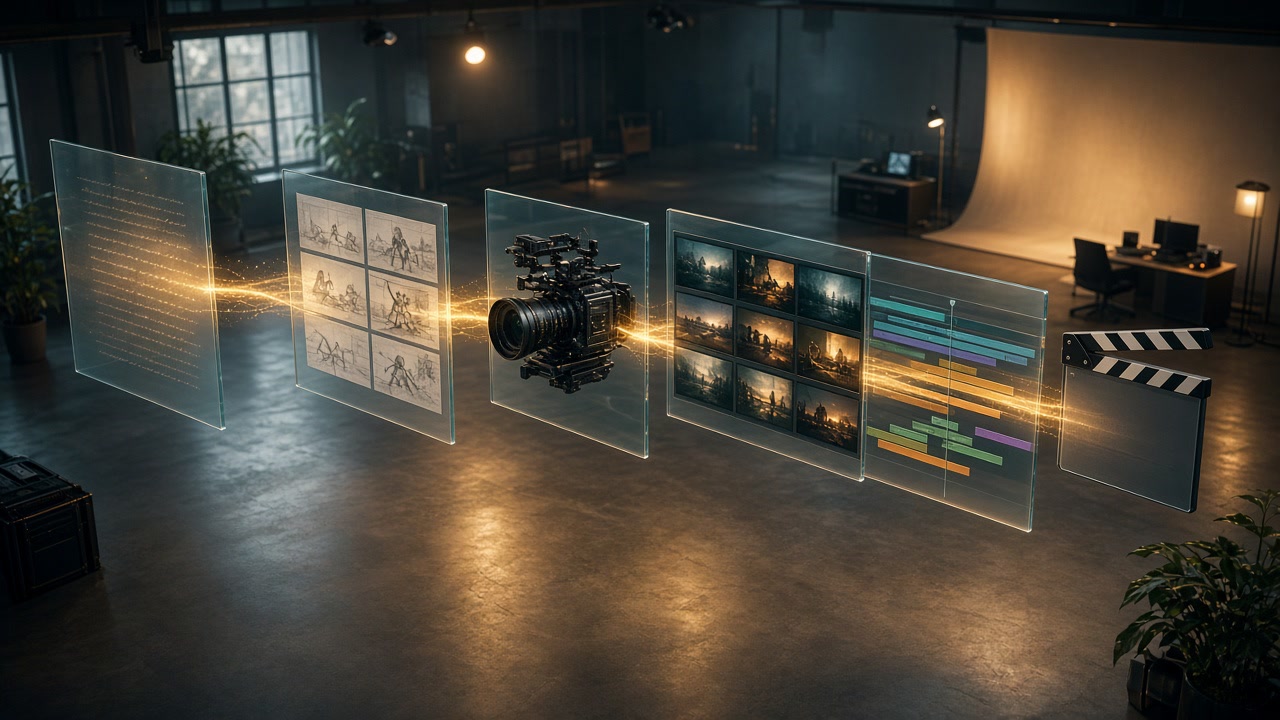
Utopai Studios introduced the all-new PAI and Utopai X on September 30. PAI stands for Production Assistive Intelligence, and it covers a lot of ground. It breaks a screenplay into scenes and shots, keeps characters, locations and objects in a Production Library, offers AI Production Assistants that work from the project’s own material, and tracks version history. There’s a visual canvas, an editing timeline, and a handoff of selected footage into Adobe Premiere and DaVinci Resolve.
Utopai X is the studio’s own text-to-video model, which Utopai says “builds on an existing video foundation model.” The company says it ranked No. 2 globally, with an Elo score of 1,150, on Artificial Analysis’ Text-to-Video Leaderboard With Audio in the September 29 results. That’s Utopai’s own report, and I haven’t checked it against the leaderboard myself. What I find most interesting is that Utopai is using both tools on its own productions, including Mike Bender’s upcoming animated feature.
That NLE handoff matters more than it might seem. Editors live in Premiere and Resolve, so a tool that meets them there respects the way films actually get finished.
A regional studio goes AI-native
Over in Dubai, MForMedia, the company behind the Arabic versions of Carpool Karaoke and The X Factor, signed a partnership with Arcana Labs. Deadline reports that Arcana’s software will be built into MForMedia’s production workflows, Arabic-language co-productions and staff training. The two will co-produce original content for audiences in the Middle East and North Africa, and MForMedia staff get a five-day AI-native production workshop as part of the deal.
Arcana CEO Jonathan Yunger put it simply: “we are embedding an AI-native pipeline inside a regional studio from day one.” I love that the deal includes training. Tools are only half the story, and the people using them need time to learn.
Real talent, real dates
The announcement that made me smile was The Hollywood Reporter’s story on three AI-assisted holiday shorts from Massive Studios and CapCut, produced by Todd Garner. Massive co-founder Reza Sixo Safai directs from scripts by The Garfield Movie writers Paul A. Kaplan and Mark Torgove. The team is using CapCut’s Video Studio and Seedance 2.5, and says the shorts began as hand-drawn designs by artists and are combined with actor performances.
There’s a trailer planned for Thanksgiving weekend, and the films will be free on Christmas Eve. No streaming or distribution partner has been announced yet. Safai told THR he wants the work to feel “emotionally handmade,” and that “you can still feel the people behind every frame.” That’s a lovely way to think about these tools.
Runway also launched Runway Ads on September 30. It’s an agent that generates ad creative from a brand kit, publishes approved variants to Meta, Google and TikTok, reads performance back and makes the next round, with human approval on by default. It’s in pilot with select enterprise partners, and Adweek names Lovable as the launch partner. Runway says its own weekly ad volume grew from 77 to roughly 900 since July while cost per subscriber fell 41%, which is a vendor claim. It’s advertising rather than film, and it shows the same pattern: generation, publishing and feedback in one loop.
Keeping perspective
I want to be honest about the scale here. None of these are deals with Disney, Warner Bros. Discovery, Universal or Netflix. They’re mid-tier studios, producers and platforms, and that’s where a lot of real experimentation tends to happen first. Some of the hyped model launches are still catching up too. As of October 1, WaveSpeed reports that the full Kling 4.0 model is still awaiting its wider October release. (I wrote about Kling’s announcement, and about Hollywood’s broader moves, on September 29.)
Performers’ concerns deserve real respect too. In an Instagram clip reported by Complex, Joseph Gordon-Levitt said the AI character Tilly Norwood “is not an actress,” adding, “In order for someone to give a performance, there has to be a performer.” He also argued that AI models are built from human work “taken without consent, without compensation.” Whatever you think of AI characters, consent, credit and pay are questions every pipeline builder should take seriously.
How to get hands-on
Here’s what I’d encourage you to try:
- Map your own pipeline. Write down every stage of a short project, from script breakdown to final mix, and note where AI could help and where you want a person in charge.
- Try an NLE handoff. Generate a few shots with whatever tool you like, bring them into Premiere or Resolve, and cut a short sequence. You’ll learn quickly what an editor needs from generated footage.
- Keep humans approving. Build review into every step, the way Runway keeps approval on by default.
- Document consent and credits. If you use someone’s voice, likeness, drawings or performance, get permission in writing and credit them properly.
- Start small and finish something. A 30-second piece you complete will teach you more than a feature you only plan.
The tools are getting more complete, and the people using them are bringing real craft. I can’t wait to see what you build.