Paul Schrader just told Deadline, from Venice, that a movie he had been developing with Antoine Fuqua is now an AI project. The piece that used to be called Three Guns at Dawn is being reconfigured. Fuqua is no longer involved. That is a named auteur putting a real title on the table, and I sat up when I read it.
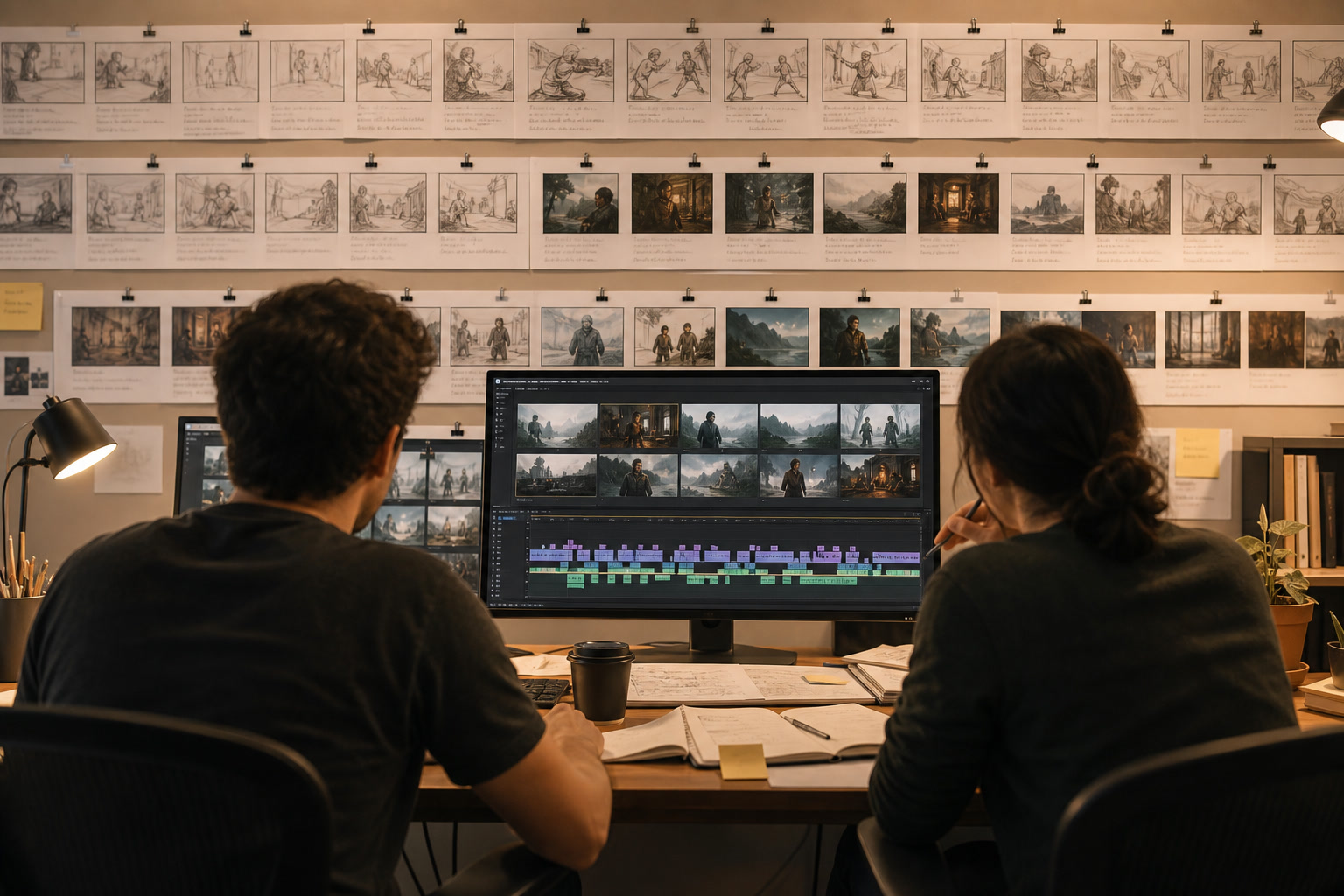
The interesting AI-film story right now is this kind of move: named projects, and the institutional workflows that have to hold a character from one shot to the next. Clip generators got us here. Continuity, review, and edit retrieval are what will decide whether these projects can actually finish.
What Schrader actually said
He was in Venice with The Basics of Philosophy, talking about guilt, Spinoza, and three films he still plans to shoot. The Fuqua question came late in the interview. Schrader’s answer was short. The project has become something different. It is now an AI project.
He did not define what that means. There is no method, no financing, no cast, and no schedule in the piece. It may be an experiment. It may become a greenlit feature. I would not pretend to know. What I would take from it is simpler. A filmmaker with Schrader’s history is willing to say the words in public, attached to a project that already had a conventional shape. If you teach directing, that sentence belongs on a slide next to the caveat: we do not yet know the workflow.
DeNA is testing continuity inside a real pipeline
The same day, Variety reported that DeNA’s Entertainment Development Business Unit will fold Utopai Studios’ PAI storytelling system into experimental animation workflows in Japan. Utopai specialists will sit with DeNA staff on early visual concepts, character and environment design, scene planning, and iteration. DeNA artists keep final authority over story, style, performance, and tone.
PAI’s claim is the part that matters for anyone who has ever watched a generated character drift between shots. Once a character, background, or design element is approved, the system is supposed to carry it across shots, scenes, and episodes instead of rebuilding it each time. That is a continuity-first pitch, from early visualization through edits and asset storage.
It is also an evaluation. Permissions, IP, and security rules still have to be jointly negotiated. Minabe Naoki, who heads DeNA’s entertainment unit, said they will explore how AI can help creators focus on craft while making workflows more efficient, as an initiative separate from DeNA’s other animation productions. Cecilia Shen, Utopai’s CEO, talked about combining new production capabilities with the artistry and authorship that define good animation. Those are the right words. The test is whether approved assets actually persist when a Japanese studio’s artists are the ones signing off.
Tools that sound like production, not a demo reel
Around those two stories, the vendor news is starting to sound like a pipeline. Reallusion shipped AI Studio 1.1 as a standalone app, with Seedance 2.5 and another pass at character consistency, plus 4K image, video, and 3D-to-video. Nura opened public early access to Showcraft, which takes scripts and shot lists toward storyboards, animatics, animation, and a final edit, with ACES in the mix. Google turned on agentic video understanding in the Gemini API for 3.7 Flash, 3.6 Flash, and 3.5 Flash-Lite, so a model can search frames, audio, and transcripts, pull a moment in under a second, and help with automated editing. Google reports up to 88 percent fewer tokens, 66 percent lower analysis cost, and 7 percent better accuracy. Those last figures are company-reported maxima. Treat them as a vendor slide until you run your own timeline.
I would put Gemini in the review-and-post column, not at the top of the page. Finding a line of dialogue in a pile of dailies is a real job. Generating another pretty clip is a different job. The first one is what editors have been asking for.
A note on labor, from a series already shipping
Chosun Biz wrote about Hou’s Journey to the West heading from Mango TV to Hunan Satellite TV prime time: 30 episodes, 40 minutes each, built with Seedance, 109 character assets, and 143 scene assets. The credits list nine AI directors, two AIGC heads, six AIGC ops people, and 30 AI production staff. Total costs have not dropped as sharply as the compute, because selection, revision, regeneration, and post still take a lot of human hours. That is television, not a feature, and it is the reality check I would keep next to any “AI project” announcement. The model can draft. People still choose.
Time to dig deeper
Read Schrader’s Deadline interview and Variety on the DeNA and Utopai evaluation. Then ask a practical question of your own next scene: what has to stay the same from shot to shot, and who has final say when the system drifts? If you get a chance to try Showcraft, Reallusion, or Gemini’s video search, run them on material you already know and write down where continuity holds. Named projects will keep arriving. The pipelines that can carry a face across an episode are the ones worth learning.