For years, the AI film conversation has lived on social feeds, festival screens and demo reels. On October 23 it walks into a cinema and asks people to buy a ticket. I find that genuinely exciting, and a little nerve-racking, because box office numbers are about the most honest feedback a filmmaker can get.
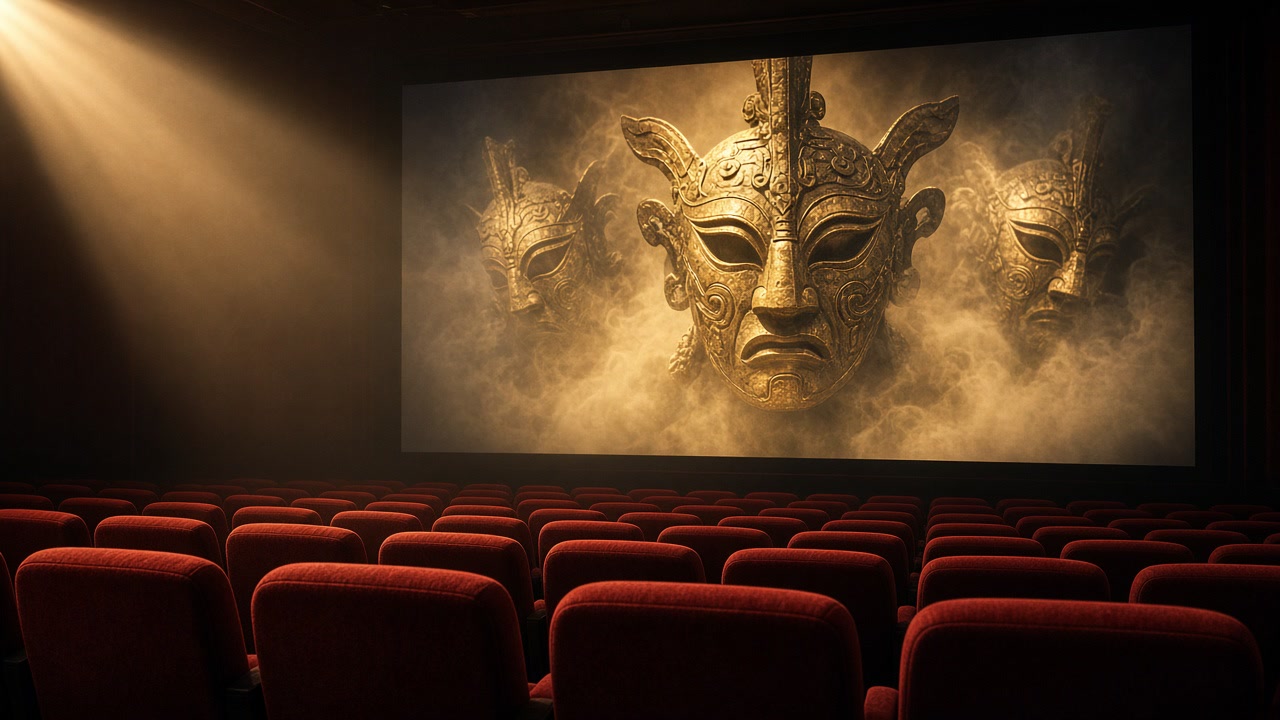
A permitted feature, made with AI
Global Times reports that Sanxingdui is China’s first fully AI-generated feature film to receive a theatrical release permit, and that it is set to hit cinemas on Friday, October 23. The promotional material is credited to Bona Film Group, and one of the film’s producers, Jiang Defu, is Bona’s COO.
The story draws on the Sanxingdui ruins in Sichuan Province, famous for their striking bronze masks and sculptures from the ancient Shu civilization. According to producer Qu Jixiaojiang, the film uses mysterious symbols engraved on those bronzes to link an ancient civilization with a future confronting superintelligent AI. She told Global Times that the team consulted Sanxingdui experts on separating established archaeological evidence from open academic questions and cinematic imagination. I love that detail. It suggests a team that cared about getting the history right while it played with the future.
The work behind it
I want to linger on the production story, because it pushes back on the myth that AI films come from typing a prompt and waiting. Here are the figures, all as reported by Global Times from the filmmakers:
- More than two years of development.
- More than 1.2 million preliminary images generated.
- More than 100 full-film iterations before reaching the final cut, and Qu said the team substantially reworked the film from beginning to end at least five times.
- Over 10 million yuan to make, which Global Times puts at about $1.5 million.
- 17 professional functions, according to Jiang, with roles covering screenwriting, directing, production, art design, cinematography, lighting, sound and editing.
Jiang also described a step I think every creator working with generative tools will recognize. Images that looked fine on a phone did not necessarily hold up on a cinema screen, so different groups of reviewers went through the film frame by frame to find problems. That is craft, and a lot of it.
Global Times also reports that the film was presented at the Cannes Film Festival, where an international trailer was released, and that Malaysia plans to release it on the same Friday, with talks under way in markets including Russia and France.
Why this is the real test
A release permit gets a film onto screens, and from there the audience gets the final say.
The producers seem very aware of that. Global Times notes that online reactions to the trailer included skepticism, with some people asking why they should pay for images that seem cheap to create. Qu said she understood those reservations, and that the team would judge its work by the responses of people who actually watch the film, positive and negative. Whether the film recoups its cost is, in Global Times’ words, a question the industry is watching closely.
One quote from Qu stuck with me: “Audiences still expect a story worth watching.” I think that is the whole game. Opening weekend will tell us far more than the “first” label ever could, and I will be watching the numbers with real interest.
AI films are finding other doors too
Theatrical release is one route. Several other moves show how many paths are opening up for this kind of work.
Connected TV. Televisual reports that Wonder Studios struck a deal with Foundation Distribution to bring AI-native content from emerging filmmakers to TV streaming services via platforms such as Roku, Samsung TV and Amazon. First up is the second season of Wonder’s anthology Beyond the Loop. Wonder says the series has drawn 14.8 million combined views across all platforms, and Season 2 was executive produced by CapCut, ElevenLabs, OpenArt and invideo. Each film will appear as its own title, which feels like a sign of respect for the filmmakers.
A volume studio. In a press release, TriCoast Advanced Technology Studios says it aims for 35 or more features a year once fully operational, at an average production cost of $500,000, distributed through its affiliate TriCoast Worldwide. The company says its films are made with a “Human-in-the-Loop” workflow, where human writers, directors, performers and supervisors guide and approve all AI-generated output. These are TriCoast’s own plans and projections.
Tools inside enterprise budgets. Runway announced on October 20 that eligible enterprise customers can buy Runway Creative through Claude Marketplace using part of their existing Anthropic commitment. Runway Creative bundles models including Gen-4.5, Aleph 2.0, Seedance 2.5, Kling 4.0 and ElevenLabs V4, and Claude powers the reasoning behind Runway Agent. Runway says more than 65 million creators, filmmakers and marketing teams use its tools.
Longer generations. VideoGen says its Model 1 turns text prompts and images into finished, multi-shot videos up to ten minutes long, with a limited private-partner rollout that began October 20. VideoGen also says it expects Model 1 to cost more than 50% less than comparable models based on internal validation, with official benchmarks and third-party validation still underway.
Keeping it honest
A few things I would keep in mind as the story unfolds:
- A permit is not demand. Sanxingdui clearing regulators is meaningful. Ticket sales are what will show whether audiences care.
- Self-reported numbers. TriCoast’s output plans, VideoGen’s cost and length claims, Runway’s 65 million users and Wonder’s view counts all come from the companies themselves.
- Context on the source. Global Times is a state-affiliated outlet, so I would read its framing with care and look for box office data from other sources after opening.
Go and watch, then go and make
If Sanxingdui reaches a cinema near you, I would love for you to see it with an open mind and judge it as a film. And if you make things yourself, try these tools on something small and personal. Keep people at the heart of the work, give credit to the humans who shaped it, and use likenesses and voices only with consent. Then read the original coverage for yourself, because each piece has detail I could not fit here.