For most of my career, if you wanted a robot to do something new, you needed a robotics team, months of specialized programming and a lot of patience. Over the past week, a cluster of announcements made me think that is starting to change, because the model that drives a robot is becoming something you can call over an API or download and run yourself.
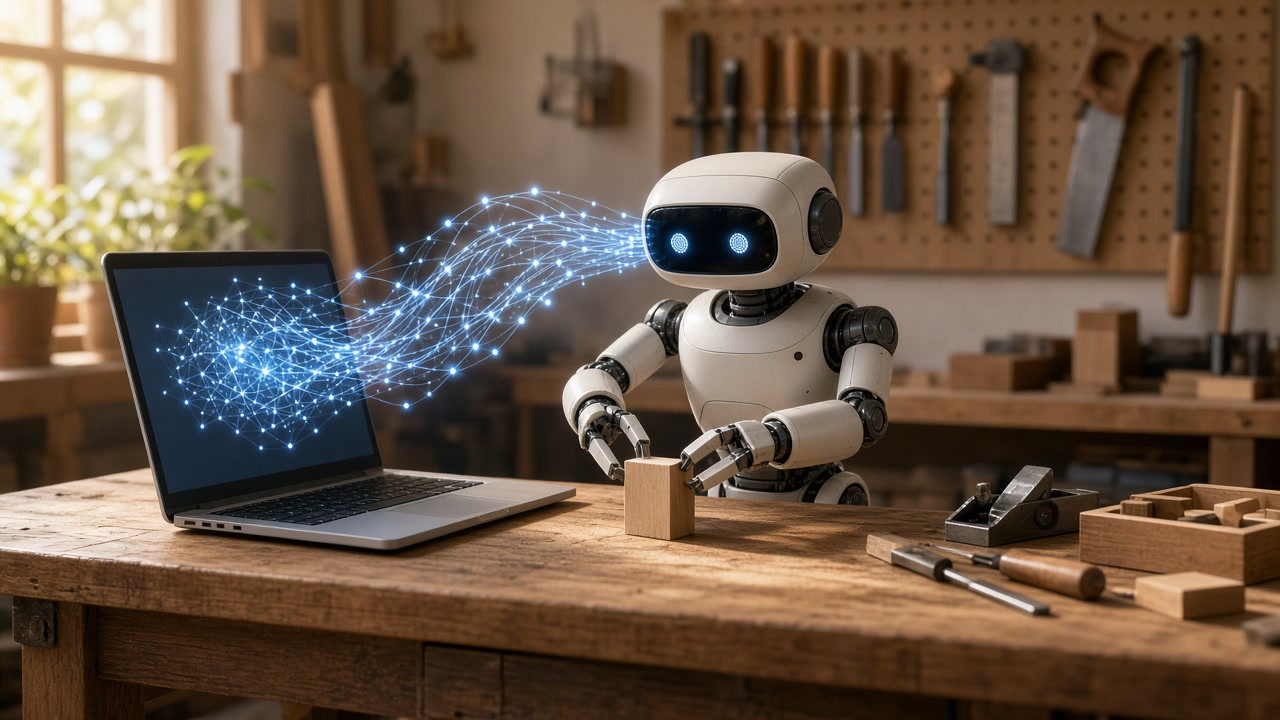
A robot brain behind an API
On October 19, SiliconANGLE reported that Dream Labs raised $90 million in seed funding, jointly led by B Capital and Kindred Ventures, alongside the launch of a public API for its robot foundation model, Dream-1.
The idea is lovely in its simplicity. Dream-1 treats robot skills as a video prediction problem, learning from videos of people doing physical tasks, then working out what action the robot needs to take. Dream Labs says it is designed to work with any two-armed robot equipped with parallel grippers, and all you need to get started is a video feed and natural language instructions. The company says Dream-1 controls robots it has never seen, on tasks it was never shown. Pricing, according to SiliconANGLE, is $3 an hour for the most capable version and 75 cents an hour for a lightweight one.
CEO Joel Jang used an analogy I really like. Climb into a rental car and you simply find the controls, then let your past driving experience do the rest. Whether a robot can really do that across hardware is exactly what developers will now be able to test for themselves.
Learning physics in simulation
On October 20, Eka Robotics announced a $150 million Series A led by Andreessen Horowitz and F-Prime. Eka is building what it calls a vision-force-action model, trained with reinforcement learning at scale in simulation, so the robot learns from both what it sees and what it feels.
Eka says its robots can pick a wide variety of objects outside their training distribution at 1,500 operations per hour, roughly two and a half times its stated human baseline of about 600. Those are Eka’s own figures. I love the framing of feel as a first-class input, because anyone who has tried to pick up a ripe raspberry knows vision alone won’t get you there.
An open toolbox from NVIDIA
On October 21 at GTC Berlin, NVIDIA announced a broad expansion of its Isaac robotics platform. The pieces that stood out to me as a developer:
- Isaac Lab 3.0 is generally available, an open source framework for training robot policies from desktop to data center.
- Isaac OS, a new open source runtime that connects AI, sensors, controls and robot hardware for real-time performance from simulation to physical robots.
- Data on Hugging Face: the SimReady Central Library with more than 2,000 simulation-ready assets, plus the Human 1M Dataset of human activities with synchronized three-view video and 3D hand tracking. NVIDIA says the full Human 1M Dataset is accessible to Cosmos Coalition partners.
- Agile ONE SN, a reference humanoid from Agile Robots built on NVIDIA Isaac GR00T and Jetson Thor, scheduled to be available in early 2027.
Open weights you can download right now
The one I would point developers to first is REKI from Kyutai, developed with Inria and École nationale des ponts et chaussées. It is a 2.4 billion parameter vision-language-action model pretrained on public data only. The LIBERO fine-tune reports a 97.6% mean success rate across the four LIBERO suites and 90.4% overall on the perturbed LIBERO-Plus benchmark.
What I appreciate most is how clearly the model card states its limits: these results are from simulation only, with no real-robot or safety evaluation. The weights are CC BY-NC-SA 4.0, so non-commercial, and the code is MIT. It ships with files for a LeRobot plugin, which makes it an easy weekend experiment if you already play with LeRobot.
Robots leaving the lab in Korea
Policy is moving too. According to Seoul Economic Daily, a South Korean regulatory sandbox committee met on October 13 and granted Robros a demonstration exemption to deploy 20 of its bipedal humanoids at Nepes, Sungwoo Hitech, HD Hyundai Samho and Delivery Lab. The robots will work in spaces shared with or adjacent to people, cleaning semiconductor components, placing auto body parts, stacking ship scaffolding and moving refrigerated packaging. The exemption is conditional on risk assessments and safety measures, and the data gathered will help shape future safety standards.
Keeping our feet on the ground
I am excited, and I also want to be honest about where things stand.
- Most benchmarks are simulated. REKI’s numbers are simulation only by Kyutai’s own account, and Eka’s training happens in simulation. I have not seen independent real-robot success rates for any of these models yet.
- The big claims are self-reported. Dream-1’s ability to control unseen robots and Eka’s 1,500 operations per hour come from the companies.
- Deployments are small and conditional. Twenty humanoids under a sandbox exemption is a pilot, and Agile ONE SN is still a 2027 product.
- Funding is running ahead of revenue. $240 million across two rounds in two days is a bet on where this goes, and neither announcement shared revenue figures.
Go and try it
Here is my encouragement, especially if you write code. Download REKI, run the LIBERO evaluation and see the numbers for yourself. Grab Isaac Lab 3.0 and the SimReady assets and build something small in simulation. If you have a pair of arms on your desk, try an hour on the Dream API. And whichever model you pick, read the model card all the way through, especially the limitations section. That is where you learn what a model can truly do, and it is the habit that will make you a better builder of physical AI.
Read the sources
- SiliconANGLE: Dream Labs raises $90M to help build more intelligent robots with simple video feeds
- Eka Robotics: Eka Robotics Raises $150M to Build Superhuman Intelligence for the Physical World
- NVIDIA: NVIDIA Advances Isaac Platform for General-Purpose Robotics
- Kyutai: REKI-2B LIBERO model card
- Seoul Economic Daily: Korea Clears Safety Rules to Put 20 Humanoid Robots on Factory Floors